
How to Clean Concrete Garage Floors the Right Way
// We may earn a commission if you make a purchase through links on this site. Read our Earnings Disclosure to learn more.
When Bad Things Happen to Good Concrete
Concrete, the most widely used construction material in the world. The word implies solid, immovable. We say things like “that rule is cast in concrete” and have phrases like “concrete jungle.”
But take a look at the concrete jungle the next time you are there. You will see this material we call concrete is not as permanent and indestructible as our sayings imply. Look past the graffiti, and you will see the concrete is stained, cracked, and dirty. It is true:
Concrete is susceptible to dirt and stains, requiring routine maintenance.
When it comes to concrete floors, like the ones found in most garages and workshops, stains will happen. With a flat surface where you store the car, lawnmower, tools, chemicals and paint, etc., it is unavoidable that at some point, you will have to ask:
How do I clean and remove stains from my concrete floors?
It is a good question and the answer will depend on what you want to do after cleaning. If you are going to paint or epoxy coat the floors, you will want something different than if you are going to place an interlocking rubber tile on the floor. And if you are just going to leave the bare concrete floor, you may want to remove all traces of stains from things like oil and rust.
So, as happens too often, a simple question raises a number of issues. But fear not, it can be broken down into a few easy to understand topics, and the information about concrete and how to properly clean it follows.
What is Concrete and Why Do I Care?
Concrete is a mixture of:
- Sand
- Aggregate
- Portland cement
When mixed with water, it chemically reacts (“hydrates”) and becomes the hard, man-made rock we all know.
Now, you are probably asking: why do I care about this?
You should care because it provides some of the answers on how to clean this unique material.
For example, muriatic acid is sometimes used to clean concrete and masonry. But, the binder in concrete, Portland cement, is dissolved by an acid. Dissolving the glue holding all that sand and aggregate together is not a great idea.
Another example of the challenges one faces when cleaning a slab, when concrete hydrates, it produces calcium hydroxide as a byproduct (this is why concrete is an alkaline material). The calcium hydroxide further reacts with carbon dioxide in the atmosphere to form calcium carbonate, which is the white, dusty material you commonly see on the surface of concrete (this is called “efflorescence”). It can become heavy enough that you may need to clean it off.
But if you use an acid based cleaner, the acid pulls more calcium hydroxide out of the hardened concrete, which then quickly forms even more white, dusty staining. I don’t know about you, but it is reasonable to say that creating more of a stain while trying to remove it is not appealing.
While some might think of cured concrete as a hard, dense rock, it is not. The mixture of cement, sand, and aggregate is porous after it is mixed with water and cures. This allows stains like rust and oil to penetrate down into the concrete. Therefore, to remove the stain, you need something that will also get into the concrete and lift the offending spot.
(Bonus nerdy fact, this porous nature is why freezing and thawing causes “spalling” of the surface and you should never, ever use deicing salts on concrete. The salt gets into the top layer of concrete and increases the number of freeze thaw cycles, accelerating the popping and spalling.)
All that said, it should be evident that concrete is a unique material requiring knowledge and care to properly clean and remove stains, without causing further damage.
Now I know you may be fading on me so, enough background information, let’s move on to the cleaning guidelines!
How to Clean Concrete Garage Floors by Hand

A good place to start is with general, routine cleaning. A concrete floor will accumulate dirt and debris and can include things like leaves, grass clippings, dead bugs, efflorescence, etc… Concrete floors should be swept regularly to keep them clean.
If dirt and debris is allowed to accumulate, it can trap water. This trapped moisture will leach stains from organic materials and the aforementioned white, dusty efflorescence will appear.
So, one of the simplest strategies to keeping your concrete floor in tip top shape is sweeping regularly. Sounds easy, and it is (especially if you use a quality, wide push broom).

But as mentioned already, stains and heavy soiling of concrete floors will happen at some point. You will need to do a little more than just sweeping every now and then.
To clean the floor, we will need to employ some sort of cleaning product. The cleaning process requires:
- Select your cleaner
- Mix the cleaner, if necessary
- Apply the cleaner to the floor
- Scrub
- Wait
- Scrub again
- Rinse thoroughly with water
**Warning** Let me stop for a second and point out that this next section is for general cleaning of dirty concrete floors, not oil stain, rust, or paint removal. We’ll cover oil removal further down. Oil requires more than general cleaners and scrubbing. **Warning**
You can use a dry household cleaner like Tide, or you can purchase a product made specifically for cleaning concrete like Simple Green Concrete and Driveway Cleaner.

Mix the cleaner you are using (if necessary, some you pour straight out of the bottle onto the floor). For a less soiled floor, a household cleaner like Tide can be mixed at ½ cup to 1 gallon water. You can vary the mixture depending on how much cleaning power you need and the quality of your concrete. For more heavily soiled floors, I prefer to wet the floor and sprinkle the powdered version of Tide over the floor, then proceed to the scrubbing step.
Once your cleaner is selected and mixed, apply it to the floor. Do not be shy, you want to use plenty of cleaner. But one quick tip, it should always be kept wet and never allowed to dry. If it does dry, it will be hard to remove and may leave a residue.
After applying the cleaner, scrub it into the surface and then let it sit for five to fifteen minutes. If using a household cleaner, wait ten minutes. Follow the manufacturer’s instructions if you use a commercial cleaner. After the soak period, scrub again and then rinse. Make sure to use plenty of water when rinsing the floor down.
So, it is a straightforward process to clean a concrete floor, but some of the details are important and need to be discussed.
- Do not let the cleaner dry, ever. It will become difficult to remove and may leave a residue if allowed to dry.
- Break the floor into sections that are easily managed. As mentioned, the cleaner cannot dry and the contact time of cleaner with the floor must me be kept minimal, or etching can occur with some cleaners. Work in sections that keeps things under control.
- You will be using a fair amount of water and anything left in the area will get wet. Therefore, it is good practice to remove anything not bolted down and protect things like walls and equipment that cannot be moved with tape and plastic.
- The brush you use to scrub makes a big difference. There are special scrub brushes sold for this job and using the right brush results in a cleaner, better-looking floor. The pros like Tampico fiber scrub brushes, and although once hard to find, today they are readily available.
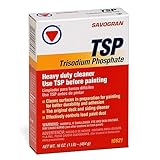
One general cleaner we need to mention is trisodium phosphate (“TSP”). This chemical was a tried and true choice for concrete and masonry, and some still use it because it is cheap and does the job well. Plus, it is alkaline, so it does not harm the concrete like an acid based cleaner.
But, it can harm you.
TSP is alkaline enough to cause skin irritation, or even burns, and the phosphate is not considered eco-friendly. So, for these reasons it is no longer considered the first choice for routine cleaning.
For regular cleaning, you may want to consider some of the TSP substitutes on the market, like Red Devil TSP/90 Heavy Duty Cleaner or Savogran Liquid TSP Substitute Cleaner.

These products do not contain the phosphate, which addresses the drawbacks with TSP. They do tend to be a little more expensive than “real” TSP, but they are gentler on you, bodies of water, and water treatment systems.
For routine cleaning, they usually get the job done.
But there are times when you might want to step up the cleaning power. The first thing you can try is the “real” TSP. Just be sure to protect yourself and minimize the water runoff. It will clean more aggressively than the phosphate free products, and that may be enough for your job.
If not, then we need to take things up a step.
Cleaning Concrete Garage Floor with a Floor Buffer
You can employ a floor buffer fitted with a special scrub pad made for cleaning concrete. These powered buffers will scour the floor, replacing the manual scrubbing with a brush. The buffers can be rented, and the rental companies often sell the scrub pads, too. If not, you can find scrub pads for buffers at your local home supply store.
To use, the process is almost identical to the general cleaning guidelines above, but instead of scrubbing with a brush, you will replace the scrubbing with buffing (say that three times fast!). Work in sections to manage the process. You still need to prevent drying of the cleaning product. If necessary, apply a small amount of water to keep things nice and wet. Buff, then let soak as instructed for the cleaner you are using. Rebuff, adding a small amount of water if needed, then rinse thoroughly.
How to Clean Concrete Garage Floor with Pressure Washer

One thing you can do to speed up the process and increase the cleaning power is to use a pressure washer (not to be confused with a power washer which uses hot water).
For cleaning a concrete floor, the equipment used should have a pressure rating of 3,000 psi minimum and a flow rate of at least 4 gallons per minute (both the pressure and flow rate are needed to clean a concrete floor at an acceptable rate). FYI, you can rent pressure washers with these ratings, as most “homeowner” units are only rated in the range of 1,500 to 2000 psi.
I also highly recommend the use of a floor cleaning attachment (also called a surface cleaner).

This attachment not only speeds up cleaning dramatically it leaves behind a more even surface, so you don’t end up with streaks or stripes in your floor from the wand’s nozzle.
If your pressure washer has a special reservoir for soap, add a concentrate like Simple Green Concrete and Driveway Cleaner Pressure Washer Concentrate to the appropriate tank of your pressure washer. Then apply the cleaner using the lowest pressure setting on your unit.
Some prefer to scrub the cleaner after applying. Some don’t. If you have a heavily soiled floor, scrubbing will help, based on my own experience. But whether you need to scrub is dependent on the amount of dirt and the quality of the concrete. If you are not sure, employ the age-old tactic of trial and error and do a test panel without the scrubbing. If pressure washing alone does not work, you may need to add the scrubbing step.
Allow the cleaner to sit for 10 or 15 minutes, but do not allow the cleaner to dry. Then raise the pressure to 3,000 p.s.i. as well as turn off the “soap” tank (if there is no “off,” simply remove the pick-up tube in the tank). Rinse thoroughly with the high-pressure water and surface attachment to complete the cleaning process.
If you forgo the surface cleaner attachment, do not allow the wand tip to come too close to the floor, or the high-pressure water may etch the concrete surface. Depending on your unit, you will want to keep the tip about 12 inches above the surface, and maintain a constant, slight angle to the spray as you move the wand across the surface.
Most important, never let flesh come into contact with the spray fan as water at this pressure will cause injury.
If your pressure washer does not have a soap reservoir, apply your cleaner of choice manually, and once again scrub with a brush. Then let it soak and rescrub. Then use the pressure washer to scour and rinse the floor. This technique works well but will be slower compared to using a pressure washer with a soap tank.
Concrete Garage Floor Stain Removal
You cleaned your floor to make it nice and clean. But your worst nightmare occurs and there a